

.png)
Summary
- A clear guide to handrail regulations for stairs in Australia, outlining how the National Construction Code and relevant Australian Standards determine when a handrail is required and how it must perform.
- Compliance is governed by the NCC and supported by standards including AS/NZS 1170 (structural loading) and AS 1657 in certain service environments.
- In typical residential applications, handrail height is set between 865 mm and 1000 mm measured vertically from the stair nosing line.
- Building classification and stair use influence final configuration and performance requirements.
- A compliant handrail must provide a continuous and usable handhold and be securely fixed to a suitable structural substrate.
- Where integrated with a balustrade system, dimensional alignment and load transfer must be carefully coordinated.
- Confirming requirements early reduces inspection delays, redesign risk and costly rectification during certification.
We are stair and balustrade specialists, and this guide provides a practical overview of current Australian handrail regulations.
Requirements can vary depending on building type, stair design and adopted Code edition. Confirming obligations before fabrication helps avoid unnecessary redesign and approval delays.
If you are unsure how the provisions apply to your project, our team can assist in interpreting the relevant standards and guiding you through the compliance process.
Handrails guide everyday movement through homes and buildings. Most people use them without conscious thought. Behind each rail sits a clear regulatory framework governing how it must be designed, positioned and secured.
In Australia, handrail regulations for stairs are established through the National Construction Code and supported, where relevant, by Australian Standards. These provisions define minimum expectations for height, placement, continuity and structural stability. Their purpose is straightforward: to support safe movement on stairs and deliver reliable performance across residential and commercial environments.
A well-resolved handrail does more than satisfy a dimension on paper. It aligns regulatory requirements with structural integrity and architectural intent. Understanding how handrail regulations for stairs operate makes it easier to integrate safety, usability and design from the outset.

What is a Handrail
A handrail is a graspable support rail installed along a stair flight to assist safe movement between levels. It follows the pitch of the stairs and is designed to be held comfortably and continuously during use.
Handrails are commonly installed on internal staircases, external entry stairs, split-level transitions, commercial stairways and ramps where required.
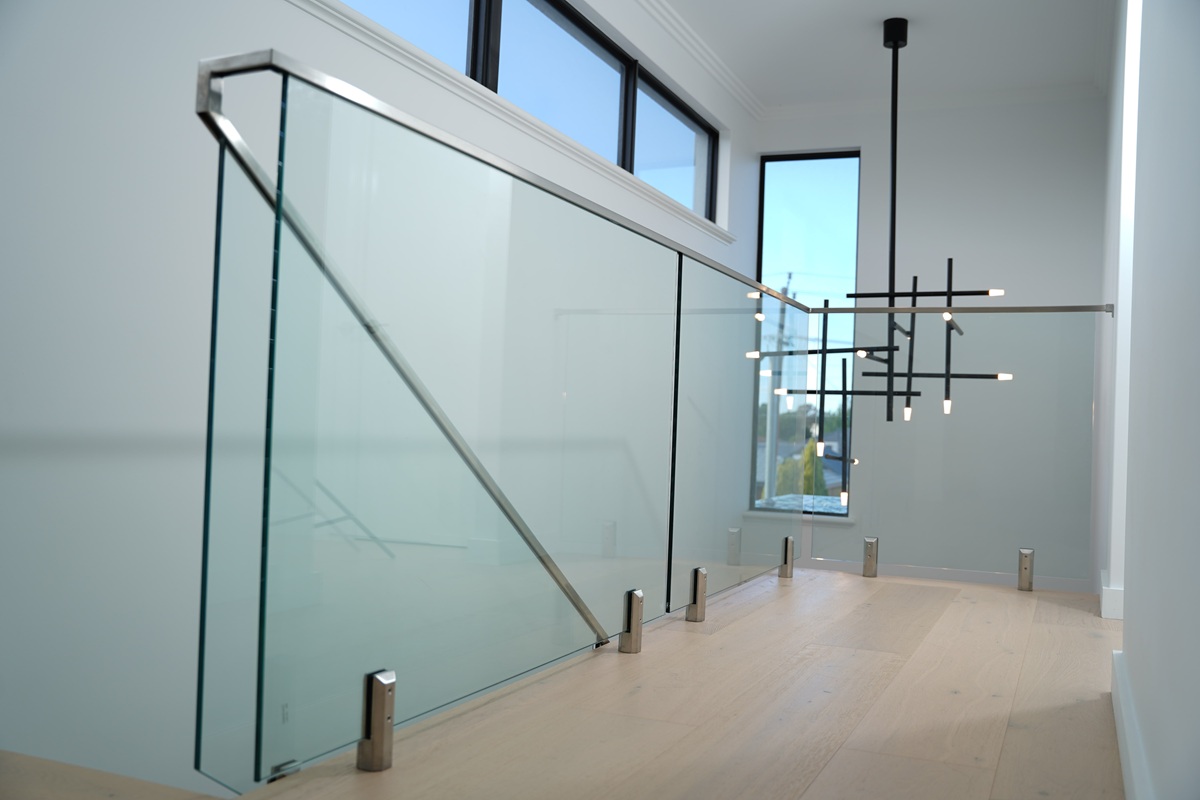
They may be wall-mounted or integrated into a balustrade system. In both cases, the function remains consistent. The rail is designed to provide a reliable handhold at the correct height and be securely fixed to a suitable structural substrate.
When a Handrail is Required
Under the National Construction Code, most stair flights forming part of normal circulation require a compliant handrail. This applies to both internal and external stairs.
The requirement is functional. Where a stair is intended for regular use, handrail regulations for stairs will typically apply.
Residential Stairs
In residential homes, a handrail is typically required along at least one side of a stair flight. The focus is on safe movement between levels, correct height, continuity and secure fixing.
Where stair widths increase or layouts become more complex, additional detailing may be required to maintain usability and compliance.
Commercial and Public Stairs
In commercial and public environments, expectations can expand. Wider stair flights, higher occupant loads and accessibility provisions may influence configuration and detailing.
In these settings, handrails may be required on both sides of the stairs. Usability provisions can become more prescriptive, and structural durability is assessed with greater scrutiny.
Alterations and Existing Stairs
Renovations can activate current compliance requirements. Replacing a stair, modifying tread geometry or adjusting finished floor levels may require the handrail to align with the adopted edition of the Code.
An arrangement that complied at the time of construction may not satisfy present-day handrail regulations for stairs. Confirming requirements before fabrication reduces the risk of inspection delays and rework.

The Regulations That Govern Stair Handrails in Australia
Handrail requirements are applied through a structured compliance pathway during building approval. They are considered part of the stair system as a whole, alongside geometry, landings and circulation design.
The National Construction Code
The National Construction Code sets out the mandatory provisions that determine when a handrail is required and how it must be configured. These provisions address placement, continuity and usability along the stair flight.
Assessment depends on building classification. A private dwelling is evaluated differently from a commercial or public building, and accessibility obligations may introduce additional criteria.
The Code establishes the baseline requirements that must be satisfied before approval.
Australian Standards That Support Handrail Compliance
Beyond the National Construction Code, certain Australian Standards may apply depending on the stair configuration and building environment. These standards provide technical guidance that supports the broader performance objectives of the Code.
AS/NZS 1170: Structural Design Actions
AS/NZS 1170 addresses structural loading requirements across building elements. While handrails are primarily used for support rather than fall protection, they must remain stable under applied forces during normal use.
Where a handrail forms part of a balustrade system, structural loading considerations become more significant. The interaction between posts, panels and fixings may need to account for forces defined within this standard.
Understanding structural expectations early ensures the handrail system performs reliably over time.
AS 1657: Fixed Platforms, Walkways and Stairways
AS 1657 is commonly referenced in industrial and service environments. Where stairs form part of plant access, maintenance platforms or restricted service areas, dimensional and performance criteria may differ from those that apply to general access stairs under the National Construction Code.
In these settings, confirming whether AS 1657 applies during the design stage helps prevent approval complications later in the project.
Height is one of the most closely scrutinised elements of handrail regulations for stairs. Accuracy begins with identifying the correct reference point and confirming the applicable building classification.
Measuring From the Nosing Line
For stair flights, handrail height is measured vertically from the stair reference line, commonly the nosing line formed by the front edges of the treads.
In typical residential applications, handrail height is set between 865 mm and 1000 mm measured vertically from this line. The exact requirement depends on the adopted edition of the National Construction Code and the classification of the building.
Measuring from the flat tread surface or from unfinished structural levels can lead to incorrect final positioning once finishes are installed. Tread thickness, nosing projection and floor build-up are best resolved during documentation rather than adjusted onsite.
Transitions at Landings and Direction Changes
Handrail height is measured differently depending on the location along the stairs.
Along stair flights, height is taken vertically from the nosing line. At landings, where no nosing line exists, height is typically referenced from the finished floor level.
This change in geometry means that perfect alignment through transitions is not always achievable. A handrail set out consistently from the nosing line will not always align exactly when it passes across a landing or changes direction.
In practice, small variations or subtle transitions in height can occur at these points. What remains critical is that the handrail stays within the required height range and continues to provide a consistent and usable handhold.
Resolving these relationships during design helps minimise visible inconsistencies and supports a smoother approval process.
Structural Stability and Fixing
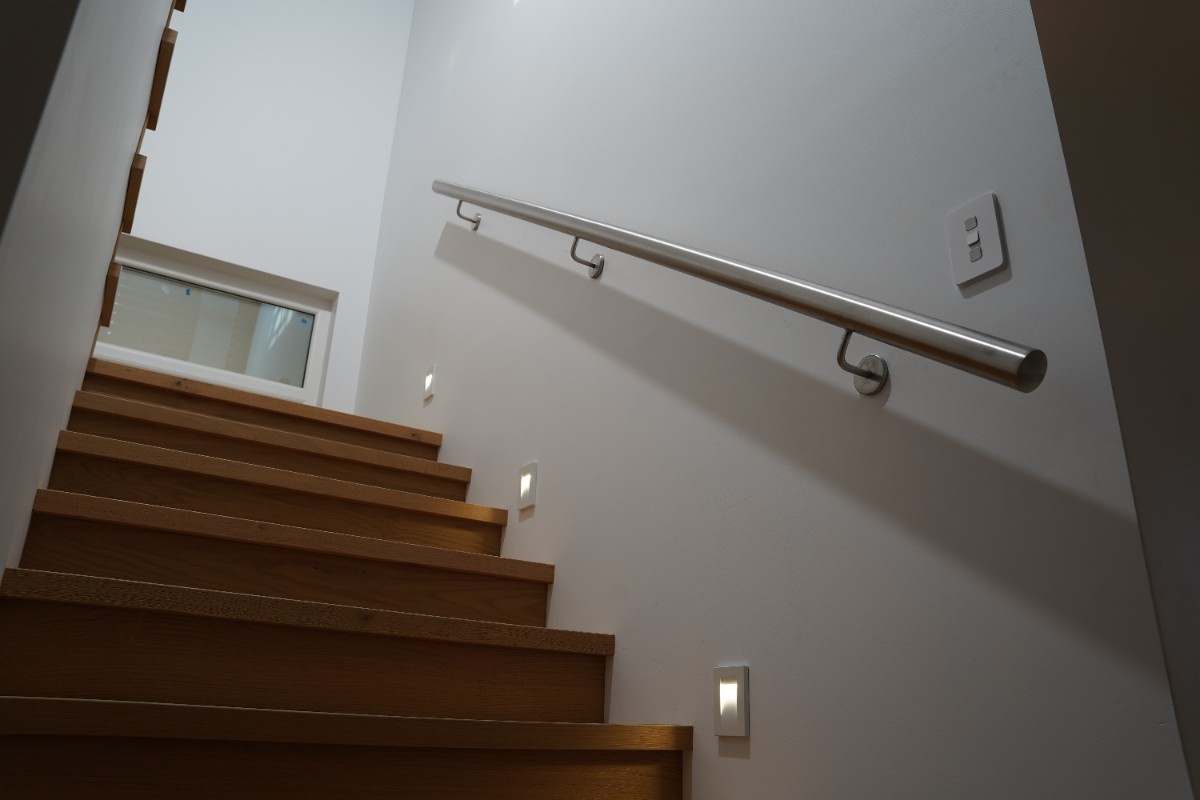
Each time the rail is gripped, force transfers through brackets and fixings into the supporting structure. Repeated loading exposes weaknesses that may not be obvious on installation day.
Structural weaknesses commonly arise where:
- Fixings rely solely on plasterboard lining
- Structural backing was not installed during framing
- Bracket spacing is excessive
- Embedment depth is inadequate
The supporting substrate remains critical. Solid timber framing, structural steel and concrete or masonry each behave differently under load. The fixing strategy must reflect that capacity.
In higher-traffic environments, expectations for durability increase. Where the rail forms part of a balustrade system, interaction between posts, panels and fixings must also be considered.
When resolved early, the finished handrail remains stable and dependable.
The Relationship Between Handrails and Balustrades
Handrails and balustrades are often designed as a unified visual element. From a regulatory perspective, they serve different functions.
A handrail supports safe movement along the stair flight. A balustrade provides fall protection at edges where a change in level occurs. In many stair designs, both elements are required.
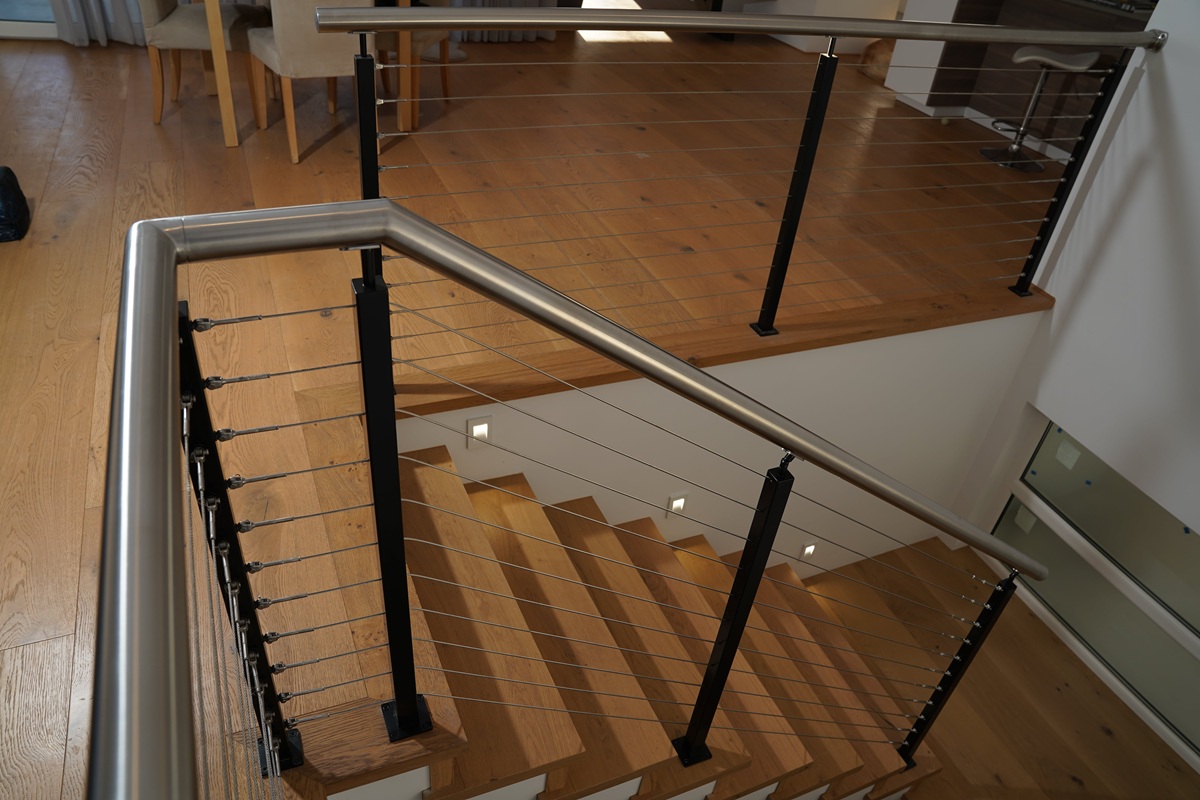
In some configurations, the balustrade top rail is intended to act as the handrail. This approach can achieve a clean architectural outcome, provided the rail sits at the correct height along the stair pitch, offers a practical and continuous grip, and performs structurally under repeated use.
Meeting barrier height requirements alone does not automatically satisfy handrail regulations for stairs. Grip, continuity and fixing performance must also align.
Coordinating these elements during design ensures the finished stair performs reliably without visual compromise.
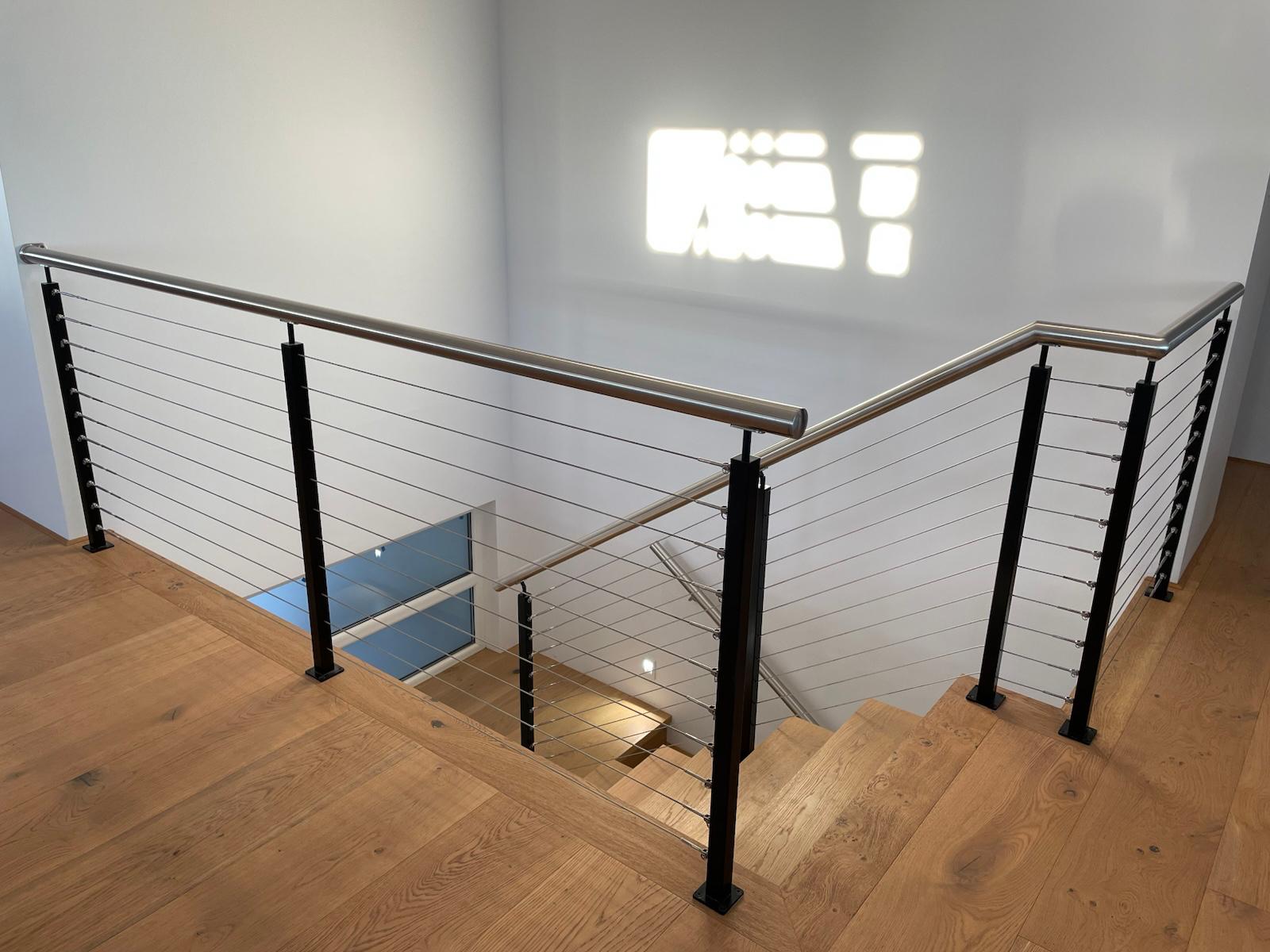
Design Considerations That Influence Compliance
Handrail compliance does not begin at installation. It is shaped by design decisions made well before fabrication begins. Profile selection, material choice, stair geometry and integration with surrounding elements all influence whether handrail regulations for stairs are satisfied.
Profile and Grip
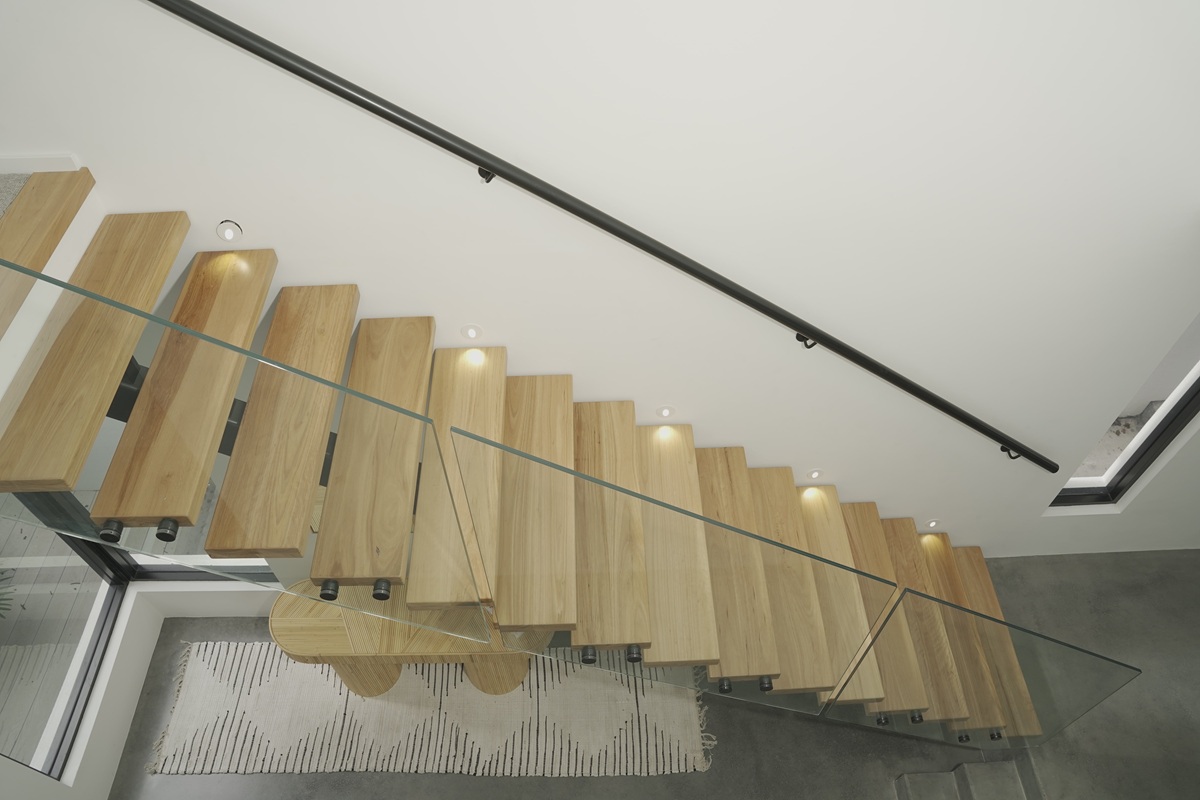
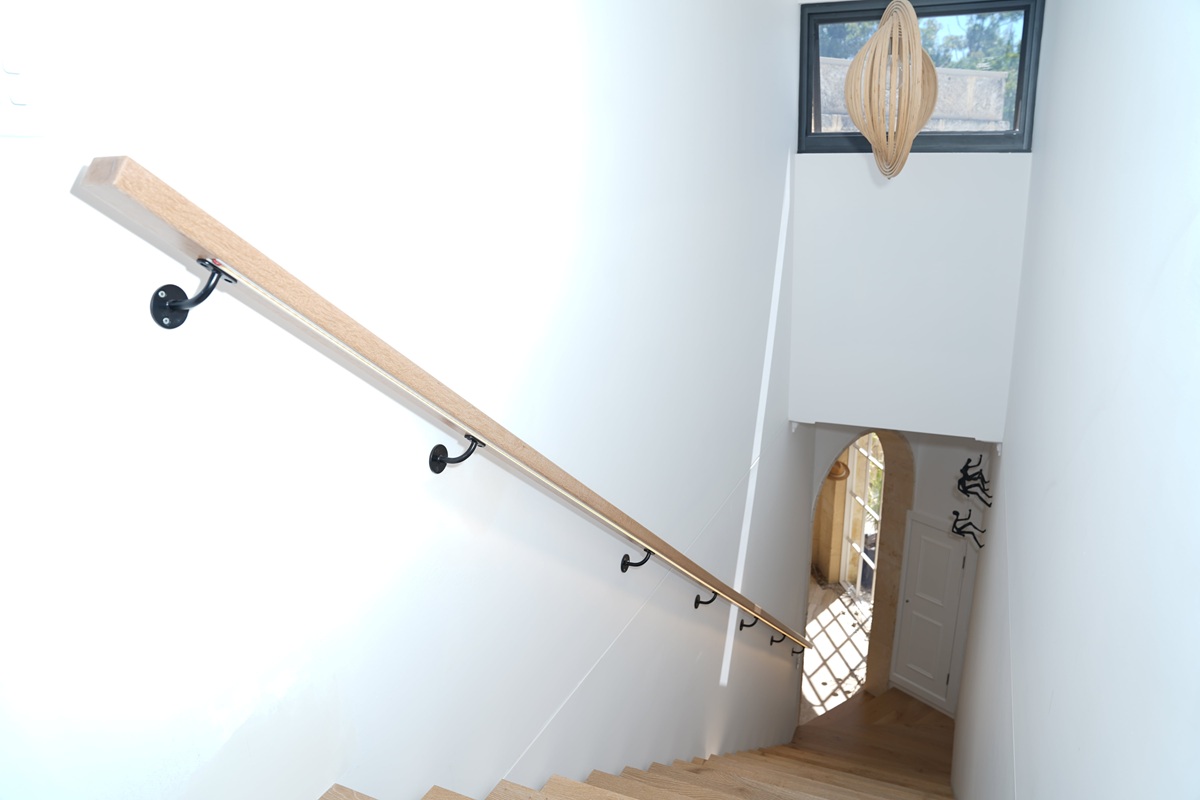
The size, shape and material of a handrail affect usability. Stainless steel rails are commonly circular and provide consistent grip geometry. Timber handrails can be shaped for ergonomic comfort and offer a warmer tactile finish. Powder-coated steel profiles allow visual alignment with surrounding finishes while maintaining structural performance.
Profiles that are overly wide or flat can reduce grip effectiveness, particularly in environments where accessibility provisions apply. Aligning aesthetic intent with functional performance avoids unnecessary redesign and supports a smoother certification process.
Stair Geometry and Set-Out
Handrail positioning follows stair pitch. Changes in tread depth, nosing detail or finished floor build-up can affect final alignment. Without early coordination, minor dimensional adjustments can create compliance inconsistencies.
Material selection can also influence bracket spacing and fixing strategy. Timber rails may require concealed structural backing. Stainless steel or powder-coated steel systems rely on appropriate embedment and load transfer into framing or masonry.
Clear collaboration between stair fabrication and finishing trades ensures the installed rail remains aligned with regulatory requirements.
Integration With Balustrades
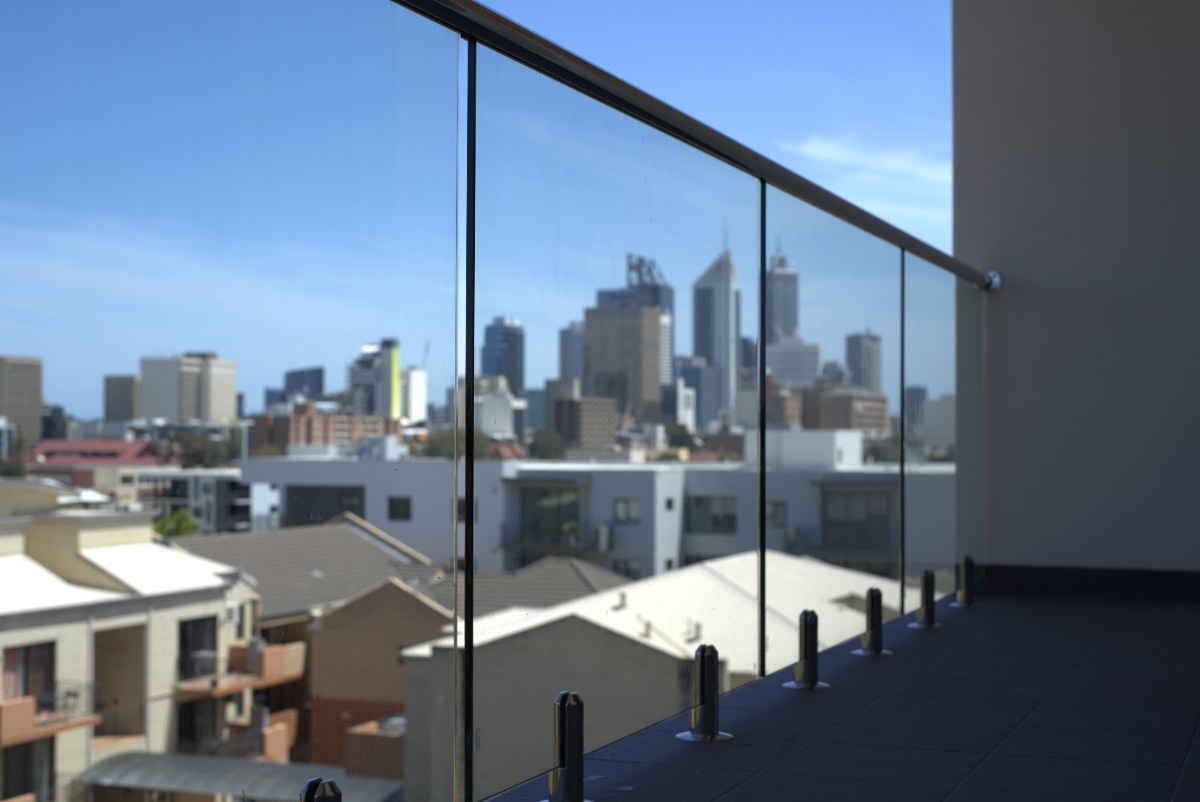
Where handrails integrate with glass or feature balustrades, structural behaviour and dimensional relationships must be resolved together.
A balustrade top rail may satisfy barrier height, yet still fall short of handrail positioning or grip requirements. Designing these components independently increases the likelihood of misalignment or inspection concerns. Coordinating them from the outset results in a cleaner, compliant outcome.
Common Handrail Compliance Mistakes
Handrail compliance issues rarely arise from a single major oversight. More often, they result from small coordination gaps or a misunderstanding of how different regulatory provisions interact.
Measuring From the Wrong Reference Point
Handrail height must be measured vertically from the stair nosing line, defined as the line connecting the front edges of the treads.
Setting out the rail before final floor finishes are confirmed can create discrepancies. Thick timber overlays, tiles or carpet can reduce the effective height once installed.
A rail positioned at 900 mm from the structural substrate may fall below the required 865 mm minimum once finishes are complete. Accurate coordination of finished floor levels during documentation prevents this issue.
Confusing Handrail Height With Barrier Height
Handrail height and balustrade height are governed by different provisions.
A handrail in a typical residential setting may be positioned between 865 mm and 1000 mm. A balustrade protecting a fall greater than one metre must be at least 1000 mm high.
Where a balustrade top rail is intended to serve as the handrail, it needs to satisfy both requirements. Height, grip and positioning must align simultaneously to achieve compliance.
Insufficient Clearance From Adjacent Walls
A handrail must allow a secure and continuous grip.
Where accessibility provisions apply, standards such as AS 1428.1 may require minimum clearance between the rail and adjacent surfaces, often around 50 mm.
Using brackets that are too short or positioning the rail too close to decorative finishes can restrict hand access and compromise usability.
Clearance requirements should be resolved during detailing rather than adjusted during installation.
Interrupting Continuity in Public Access Stairs
Continuity requirements vary depending on building classification and how the stair is used.
In residential settings, handrails are generally required along each stair flight. Where a stair changes direction, such as at a landing, the handrail may stop and restart on the next flight. This type of break is typically acceptable.
However, each individual flight must still provide a continuous and usable handhold. Interruptions within a single flight that require the user to release and regrip the rail can affect compliance.
In commercial and public access environments, continuity requirements are more stringent. Handrails are typically required to remain continuous along the stair flight and across landings, providing uninterrupted support along the path of travel.
Confirming the applicable building classification early ensures continuity requirements are resolved correctly during design.
Inadequate Fixing Into the Substrate
A handrail may feel stable at installation, yet lack long-term structural reliability if not fixed into a suitable substrate.
Fixing directly into plasterboard or relying on insufficient embedment can compromise durability.
Structural backing, such as timber noggings or steel support, should be incorporated during framing to ensure the handrail performs under repeated use.
Addressing the fixing strategy early avoids visible remedial solutions or inspection concerns later in the project.
Assuming Existing Means Compliant
Existing stairs may reflect earlier editions of the National Construction Code.
Where significant alterations occur, current handrail regulations for stairs typically apply. An arrangement that complied under previous provisions may not satisfy present requirements.
Confirming obligations before fabrication reduces the risk of unexpected rectification during certification.
How Handrail Regulations for Stairs Are Assessed
Assessment forms part of the broader stair approval process. The rail is considered in the context of how the stair performs as a complete system.
In straightforward residential projects, approval depends on clearly meeting published requirements for height, continuity and placement. When these elements are documented and installed accurately, the pathway to certification is generally direct.
Inspection typically considers whether the handrail:
- Sits at the correct height when measured from the proper stair reference line
- Provides a continuous and usable handhold
- Is securely fixed and free from movement
- Transitions cleanly at landings and direction changes
Where stair configurations depart from standard arrangements, additional documentation may be required. Feature profiles, unconventional fixing methods or integrated glass systems can increase scrutiny.
The objective remains consistent. The handrail is expected to provide reliable support during everyday use. What varies is the level of documentation required to demonstrate that performance.
Clarifying assessment expectations early in the project reduces uncertainty and supports a smoother approval process.
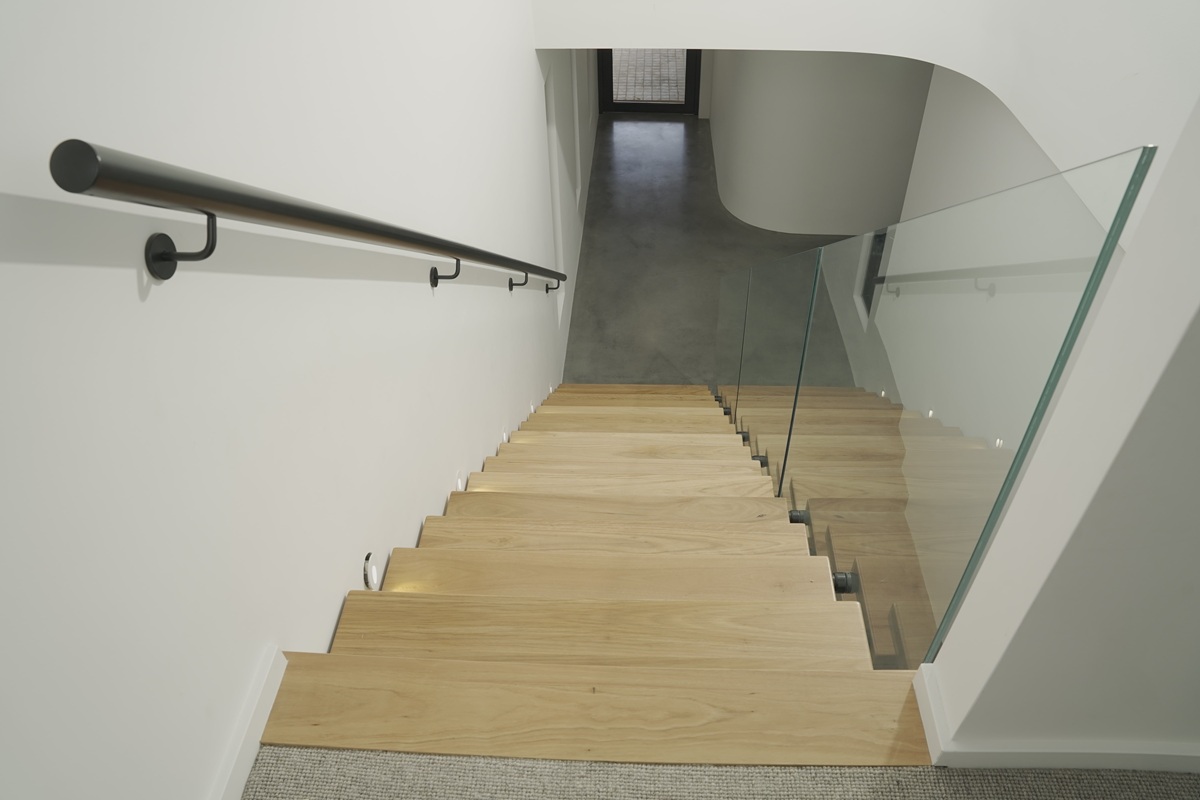
Expert Guidance for Compliant Stair Handrails
Applying handrail regulations for stairs correctly involves more than confirming a single dimension. Height, continuity, fixing strategy and overall stair design must align to achieve a compliant outcome.
When considered early, the process becomes straightforward. The handrail integrates cleanly with the stair and balustrade system. Certification proceeds clearly. The finished result performs as intended.
At Aussie Stairs, compliance is built into every stair and handrail system we design and fabricate. We work closely with homeowners, builders and designers to ensure each installation aligns with the current National Construction Code and relevant Australian Standards.
With more than 400 five-star Google reviews and the largest stair showroom in Perth, our team provides practical guidance backed by experience.
Visit our Maddington showroom with your plans and measurements or book a consultation today. We’ll confirm the correct compliance pathway before fabrication begins.
Frequently Asked Questions
Do I need a handrail on both sides of my stairs?
In most residential homes, a single handrail is commonly required. In commercial or public buildings, handrails may be required on both sides of the stair flight, particularly where stair width, occupant load or accessibility provisions apply.
Are handrail regulations different for renovations?
Renovation work can trigger current Code requirements. Replacing a stair, modifying tread dimensions or altering floor levels may require the handrail to align with the adopted edition of the National Construction Code, even if the original installation complied with earlier standards.
How is compliance with handrail regulations assessed?
Compliance is reviewed as part of the overall stair approval process. Inspectors typically assess correct height, continuous handhold, secure fixing and clean transitions at landings and changes in direction.
What is the difference between a handrail and a grab rail?
A handrail forms part of the stair system and follows the pitch of the stairs to support movement between levels. A grab rail is typically installed in bathrooms or accessibility areas for localised support. Handrail regulations for stairs are governed by the NCC, whereas grab rails are usually addressed under accessibility standards.
Do handrails need to extend beyond the top or bottom tread?
In some building classifications, particularly where accessibility provisions apply, handrails may need to extend horizontally beyond the first and last riser. This requirement depends on building type and applicable NCC provisions.
Do handrails need to be continuous in Australia?
Handrail continuity depends on building classification. In residential homes, a handrail is generally required along each stair flight, but it may stop and restart at landings. Each individual flight should still provide a continuous handhold.
In commercial and public access stairs, handrails are typically required to remain continuous across flights and landings to provide uninterrupted support along the path of travel.





.svg)