


Summary
- Stair regulations in Australia provide clear guidance on how stairs must be designed and constructed, combining the National Construction Code with Australian Standards to regulate stair geometry, fall protection, structural capacity and slip resistance.
- Compliance requires accurate application of dimensional rules, including riser heights, tread depths, landings, head clearance, handrail positioning and balustrade spacing, all working together as one coordinated system.
- The regulations apply to new builds, renovations, stair replacements, mezzanines and external stairs, with assessment based on the adopted NCC edition in each state or territory.
- Australian Standards such as AS 1657, AS 1428.1, AS 4586 and AS/NZS 1170 provide detailed technical guidance covering access provisions, surface slip testing and structural loading requirements.
- Careful planning and early verification reduce common compliance risks, including inconsistent risers, insufficient landing depth, balustrade gap failures and inadequate slip classification.
We’re stair specialists with extensive experience delivering compliant stair systems across residential and commercial projects.
This guide is an educational overview of stair regulations in Australia. It explains how the National Construction Code and relevant Australian Standards generally apply, but every project is different. Site conditions, building classification and state variations can all influence compliance requirements.
If you’re unsure how the regulations apply to your design, we’re always happy to review your plans and help guide you in the right direction.
Stairs are used every day without much thought. Yet, behind each step lies a detailed regulatory framework that governs how the staircase is designed and constructed.
In Australia, stair construction is guided by the National Construction Code and a series of supporting Australian Standards. These provisions define everything from riser height and tread depth to balustrade spacing, slip resistance and structural loading. Their purpose is simple: create consistency, reduce injury risk and support long-term structural performance.
A well-designed staircase balances regulatory alignment, structural integrity and architectural intent. Understanding how stair regulations in Australia operate makes achieving that balance far easier.

The Regulatory Framework Behind Stair Compliance
Stair requirements are not contained within a single document. They operate through a layered system made up of the National Construction Code and referenced Australian Standards.
Understanding how these documents work together is essential because stair compliance is rarely assessed in isolation. Geometry, fall protection, slip resistance and structural loading are often governed by different provisions that intersect within the same design.
The National Construction Code
At the centre of stair regulation sits the National Construction Code, commonly referred to as the NCC. It establishes the mandatory performance requirements for building work across Australia.
NCC Volume Two generally applies to housing. Commercial and public buildings fall under Volume One. Both volumes contain provisions addressing stair geometry, fall protection, accessibility considerations and structural safety.
The NCC sets the performance outcomes that a stair must achieve. In simple terms, it defines how safe, stable and usable the staircase needs to be. The detailed measurements and construction methods that support those outcomes are then referenced through Australian Standards.
Within the Code, stair provisions cover:
- Riser and going dimensions
- Maximum stair pitch
- Landings and directional changes
- Head clearance
- Barrier and balustrade heights
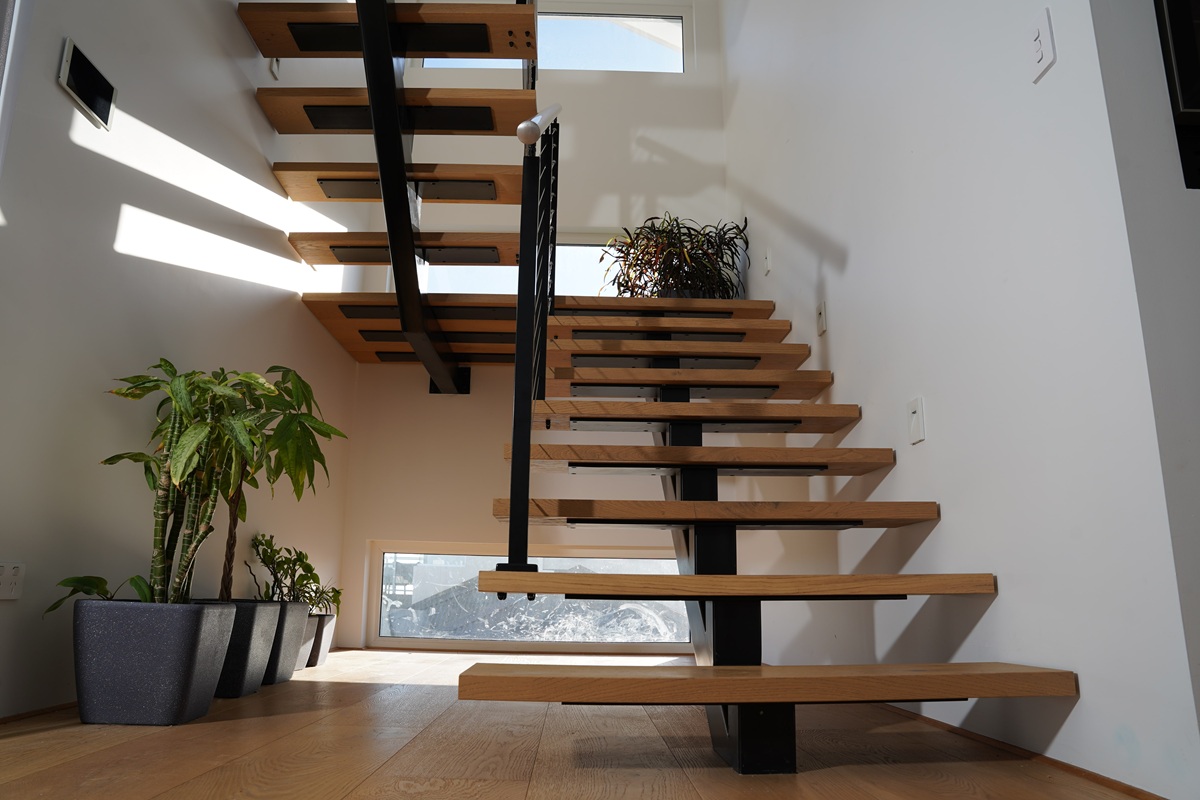
- Open riser limitations
- Handrail positioning
These provisions represent minimum benchmarks designed to create predictable and safe movement between levels. Designs may exceed them, but they cannot fall below them.
Supporting Australian Standards
Several Australian Standards provide the technical detail that sits behind the NCC provisions. They do not replace the Code; rather, they support it by outlining how compliance is achieved in practice.
AS 1657 applies primarily to fixed platforms, walkways and certain access stairways. It is commonly referenced in industrial, commercial and service environments, particularly where access is restricted or functional rather than decorative.
AS 1428.1 addresses access and mobility provisions. In public and commercial buildings, it governs elements such as nosing visibility, luminance contrast and circulation requirements, helping ensure stairs are usable for a broader range of occupants.
AS 4586 classifies pedestrian surface materials according to slip resistance performance. Its P and R ratings are used to determine whether a tread surface provides sufficient traction under expected conditions.
AS/NZS 1170 defines structural loading requirements. It ensures stair systems and balustrades can withstand the live loads, line loads and point loads generated during normal use.
In practice, stair compliance often draws from several of these documents simultaneously. A single staircase may need to satisfy dimensional rules under the NCC, slip resistance classification under AS 4586 and structural loading provisions under AS/NZS 1170.
When Stair Regulations Apply
Building a new staircase or altering an existing one brings regulatory obligations into focus.
New homes, extensions, mezzanine additions and major renovations trigger assessment against the adopted edition of the National Construction Code in the relevant state or territory.
Changes that affect riser height, tread depth, structural support, landings or balustrades typically require review.
Renovation projects can introduce complexity. Existing floor levels and structural constraints may limit available head clearance or disrupt consistent step proportions. Early dimensional verification reduces the likelihood of redesign later.
External stairs are assessed under the same core principles as internal stairs, with additional attention given to surface performance and durability.

Core Stair Geometry Requirements
Stair dimensions may seem simple, but proportion and consistency sit at the centre of stair safety.
Australian stair regulations define limits for riser height, tread depth, slope relationship and flight length. These measurements are based on how people naturally walk. Predictable geometry allows users to move confidently without adjusting stride between steps.
Riser Height
Riser height is the vertical distance between consecutive treads.
For most standard stairs, risers fall between 115 mm and 190 mm. This range supports a comfortable stride while limiting climbing effort.
Uniformity across the full flight is critical. Variations are generally limited to plus or minus 5 mm. Even minor inconsistencies can interrupt rhythm, particularly when descending.
Renovations often introduce discrepancies where floor finishes or ceiling levels have changed. These issues are frequently identified during certification if not resolved early.
Tread Depth and Going
The going is the horizontal distance between nosing lines.
For non-spiral stairs, the going typically ranges between 240 mm and 355 mm. This provides sufficient space for secure foot placement while maintaining practical overall stair length.
Consistency is just as important as dimension. Changes in tread depth within a flight can cause missteps, especially on longer runs.
The 2R Plus G Rule
Stair proportion is assessed using the formula:
2 × riser height + going = between 550 mm and 700 mm.
This relationship balances vertical rise and horizontal travel. A stair may appear compliant in isolation, but if this calculation falls outside the range, it can feel steep or awkward in use.
Any design change that alters floor-to-floor height should be recalculated using this formula.
Maximum Risers per Flight
A single uninterrupted flight is generally limited to 18 risers before a landing is required.
Limiting flight length reduces fatigue and lowers fall severity. Where the total rise exceeds 36 risers, a directional change or extended landing must be introduced to break the vertical run.
Landings and Directional Changes
Landings must be at least as wide as the stair and provide clear transition space between flights.
They allow users to pause and change direction safely. Doors should not open directly over a step; adequate landing depth must be provided at doorways.
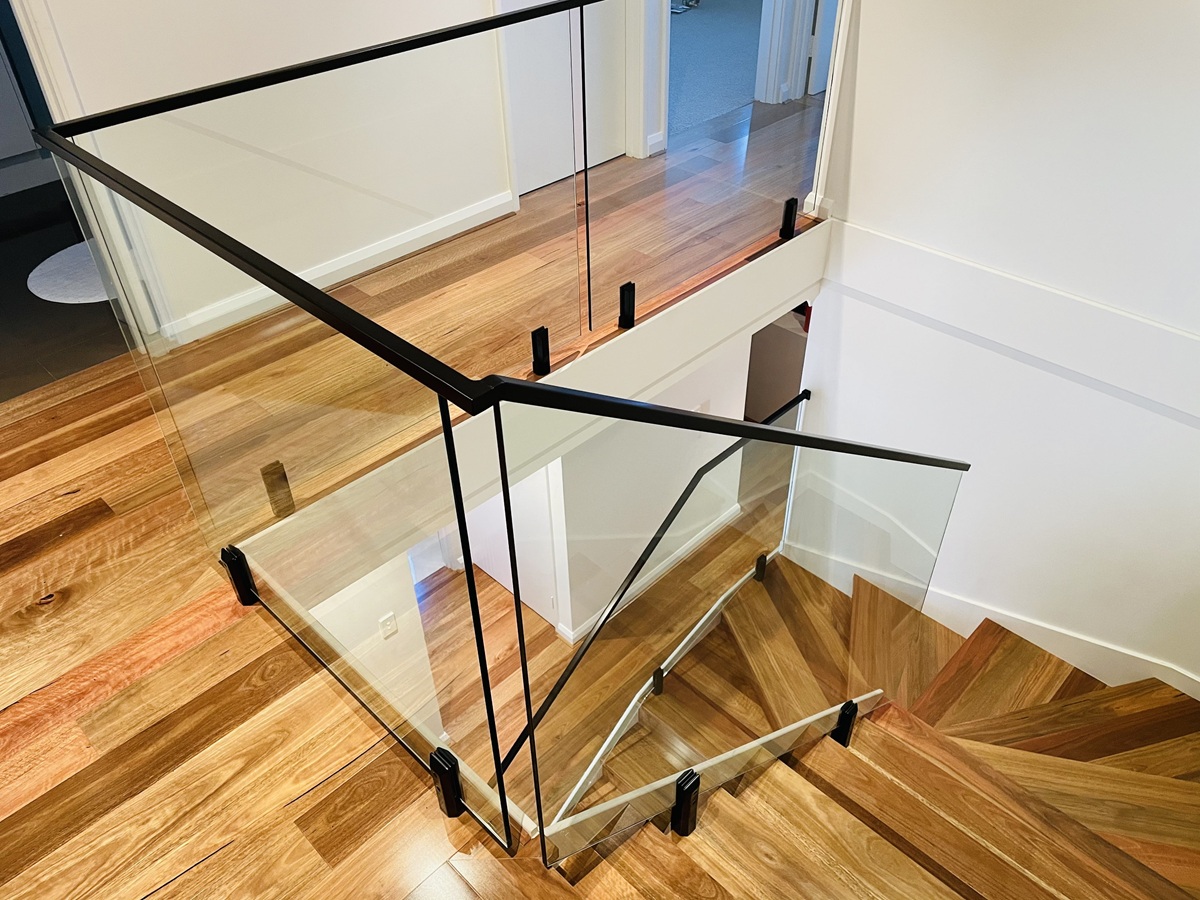
Quarter and half landings may incorporate winders, though limits apply. Winder treads must maintain sufficient depth along the nominated walking line to ensure safe foot placement.

Handrails and Balustrade Requirements
Fall protection is a fundamental component of stair compliance. While geometry governs movement, handrails and balustrades reduce the risk of injury where elevation changes occur.
Both elements are assessed as part of the overall stair system and must satisfy dimensional and structural requirements.
Continuous Handrails
Stairways are generally required to include at least one handrail. Wider stairs require handrails on both sides.
Handrail height is measured vertically from the nosing line and typically falls between 865 mm and 1000 mm. This range is intended to provide stable support for users of varying heights without requiring overreach.
Continuity is important. The handrail should follow the pitch of the stairs consistently along the full flight, including landings where required. Breaks, abrupt height changes or poorly detailed terminations can compromise both usability and compliance.
In commercial and public buildings, additional accessibility considerations may apply under AS 1428.1.
Balustrade Height Requirements
Balustrades are required wherever a fall of more than 1000 mm could occur.
Along the pitch of a stair, the balustrade height is generally at least 865 mm measured from the nosing line. On landings, balconies and mezzanines, the minimum height is typically 1000 mm measured from finished floor level.
Measurement must be taken from the correct reference points. Incorrect measurement from the tread surfaces rather than the nosing line is a common source of non-compliance.
The 125 mm Sphere Requirement
Openings within balustrades must not permit a 125 mm sphere to pass through. This requirement applies above the nosing line and across the full height of the barrier.
It affects:
- Vertical balusters
- Wire and cable systems
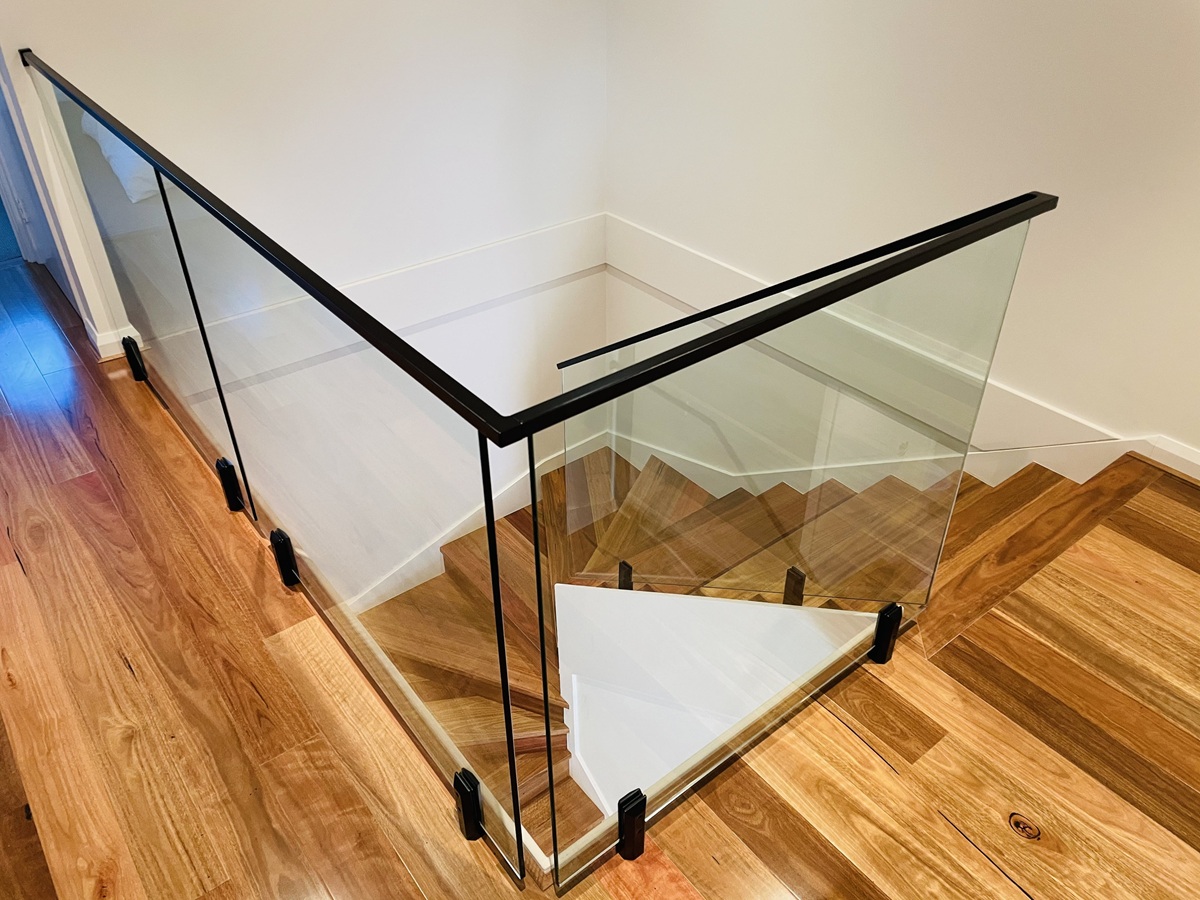
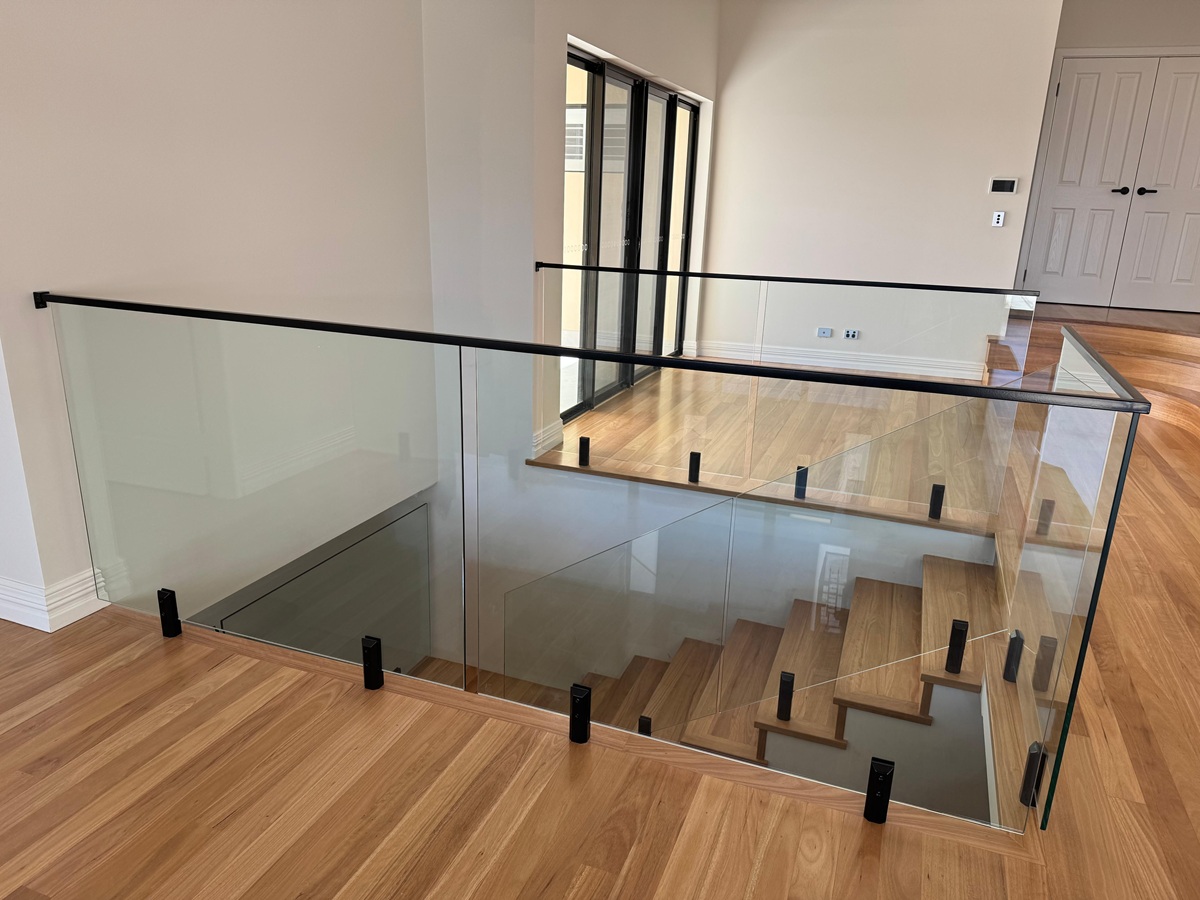
- Glass panel spacing
- Open rise stair configurations
Designs using cable systems must also consider deflection under load. Even if spacing appears compliant at rest, movement can increase the effective gap beyond allowable limits.
Open Riser Limitations
Open riser stairs are subject to the same 125 mm sphere rule between treads.
Floating or minimalist stair designs frequently encounter compliance issues at this point. Early dimensional coordination prevents redesign during certification.
Climbability Considerations
In certain applications, horizontal elements positioned between approximately 150 mm and 760 mm above floor level should not create footholds that encourage climbing.
This requirement often influences balustrade detailing, particularly in residential settings where fall heights are significant.

Slip Resistance Requirements
Surface traction plays a critical role in stair safety. Even where geometry is compliant, inadequate slip resistance can significantly increase fall risk.
Australian Standard AS 4586 classifies pedestrian surfaces using recognised testing methods. These classifications help determine whether a tread surface provides sufficient traction under expected conditions.
Understanding P and R Ratings
P ratings are determined through wet pendulum testing and are commonly referenced in building assessments. This method measures how a surface performs when moisture is present.
R ratings are derived from ramp testing and are often applied to tiled, stone or industrial surfaces. The rating reflects the angle at which slip occurs under controlled conditions.
The appropriate classification depends on location, surface material and exposure. Higher ratings are generally required where moisture, debris or frequent foot traffic increases slip risk.
Internal Stair Requirements
Internal stairs in dry conditions commonly require a minimum P3 or R10 classification. Where moisture exposure is possible, such as near entry points or in commercial settings, higher classifications may apply.
Surface finishes can alter slip performance. Polished stone, coated timber or painted steel may reduce traction if not properly specified or tested. Slip resistance should be assessed based on the finished surface, not just the base material.
External Stair Requirements
External stairs are exposed to rain, environmental variation and surface contamination. As a result, higher slip resistance classifications such as P4 or R11 are often necessary.
Slip resistance may be achieved through the base material itself or through approved surface treatments. Ongoing maintenance also plays a role. Accumulated debris, worn coatings or surface polishing over time can affect performance.
Nosing and Edge Visibility
Stair nosings should be clearly visible against the tread surface.
AS 1428.1 sets luminance contrast requirements in certain building classifications, particularly public and commercial environments. Clear visual definition between tread and nosing improves depth perception and reduces trip risk.
In some applications, contrast strips or integrated nosing systems are used to achieve both visibility and slip performance.
Structural Loading and Engineering Requirements
Dimensional accuracy alone does not determine stair safety. The structure must also withstand the forces generated through everyday use.
AS/NZS 1170 defines the loading requirements that stair systems and balustrades are designed to resist. These loads account for normal occupancy conditions rather than extreme or unusual events.
Distributed Loads
When multiple occupants use a staircase at once, weight is distributed across several treads and landings.
Stairs are generally designed to resist a minimum distributed live load of 2.5 kPa. This ensures the system remains stable under regular use in both residential and commercial settings.
Structural members, including stringers, connections and supports, must be sized to limit deflection under this load. Excessive movement can affect long-term performance and user confidence, even if failure does not occur.
Line and Point Loads
Movement is rarely perfectly distributed. People often walk along one side of a stair or pause near the edge of a tread.
For this reason, stair systems must also accommodate:
- A 2.2 kN per linear metre line load
- A 1.5 kN point load applied to individual treads
These concentrated forces influence how treads are fixed, how stringers are supported and how balustrades are anchored.
Floating stairs, cantilevered treads and glass balustrade systems require particularly careful detailing to satisfy these requirements.
Engineering Verification
Structural compliance is confirmed through calculation and documentation rather than visual inspection.
Engineering assessment considers span lengths, connection design, material properties and anchorage conditions. Proper documentation forms part of the approval process and ensures the stair performs safely over time.
Early coordination between design and structural assessment reduces the likelihood of redesign once fabrication or installation has begun.

Stair Pitch, Width and AS 1657 Considerations
Applicable requirements depend on building classification, intended use and access type.
Most general access stairs within homes and commercial buildings are governed by the National Construction Code. Stairs serving plant rooms, service platforms or industrial access areas may instead reference AS 1657.
Understanding which standard applies at the outset helps avoid design revisions later in the process.
Stair Pitch and Angle
Stair pitch refers to the angle of the stair relative to the horizontal plane.
Under AS 1657, stair pitch typically falls between 26.5 degrees and 45 degrees. Angles beyond this range may result in the structure being classified as a ladder rather than a stair, which triggers different compliance provisions.
Under the NCC, pitch is controlled indirectly through riser and going limits. When compliant riser and going dimensions are applied, the resulting stair angle generally falls within an acceptable range.
Excessively steep stairs are often the result of constrained floor-to-floor heights or reduced stair footprints. These designs may technically fit within a space but fail compliance if proportions fall outside permitted limits.
Minimum Stair Width
AS 1657 specifies a minimum stair width of 600 mm measured between handrails. This provision typically applies to access stairs serving industrial or maintenance areas.
Under the NCC, minimum width requirements vary depending on building classification and expected occupancy. Residential stairs may have different requirements from public or commercial circulation stairs.
Width must be measured between the inner faces of handrails, not between structural stringers. Overlooking this distinction can result in non-compliance even where the structural width appears sufficient.
Where AS 1657 Commonly Applies
AS 1657 is most commonly applied to:
- Fixed platforms
- Walkways
- Maintenance access stairs
- Industrial or plant room access
These stairs are generally functional rather than architectural and may be subject to slightly different dimensional provisions.
Where a stair serves restricted or non-habitable areas, confirming the applicable standard during the design phase reduces uncertainty during approval.

Doors, Landings and Clearance Requirements
The areas at the top and bottom of a stair are often where compliance issues arise. Changes in level, door swings and overhead obstructions all need careful coordination.
Clear space and headroom are just as important as riser and tread dimensions.
Head Clearance
Head clearance must generally be at least 2000 mm.
This measurement is taken vertically from the nosing line to the underside of the ceiling or any overhead obstruction. Beams, bulkheads, ductwork and sloping ceilings must all be considered.
Reduced head height is common in renovation projects, particularly where new ceiling linings or floor finishes have been added. Even small build-ups can reduce compliant clearance. Early measurement from finished floor levels rather than structural levels helps avoid redesign.
Landings Between Flights
Landings break up longer stair runs and provide transition space between flights.
A single flight must not contain more than 18 risers without a landing. Where a stair continues beyond 36 risers, a change in direction or an extended landing is required.
The landing must be at least as wide as the stair and provide adequate depth for safe movement. In larger buildings, landings also support circulation flow and reduce congestion during peak use.
Doors Opening Onto Stairs
A door should not open directly onto a step.
Where a doorway leads to a stair, a compliant landing must be provided in front of the door before the drop begins. This ensures someone stepping through the doorway does not immediately encounter a change in level.
In limited circumstances where the vertical difference is minimal, a zero tread arrangement may be permitted under current NCC provisions. The applicable requirements should always be confirmed during design.
Door swing direction, hardware placement and available circulation space all need to be assessed together to avoid non-compliance at certification.
Winders and Turning Sections
Compact layouts often rely on winders to change direction within a stair.
Quarter landings typically allow up to three winders. Half landings generally allow up to six.
Winder treads must maintain sufficient depth along the nominated walking line to allow secure foot placement. Narrow inner edges can create compliance issues if the required depth is not achieved where people are expected to walk.
Poorly proportioned winders are a frequent source of redesign, particularly in tight floor plans where the stair footprint has been reduced late in the design process.
Compliance Pathways and Design Flexibility
The National Construction Code allows more than one pathway to demonstrate compliance. The appropriate approach depends on the complexity of the project and how closely the design aligns with prescriptive provisions.
Most staircases are assessed using a straightforward method. More complex or unconventional designs may require additional justification.
Deemed to Satisfy Provisions
The majority of stairs are designed under the Deemed to Satisfy pathway.
This approach follows the specific dimensional, structural and safety requirements set out in the NCC and referenced Australian Standards. Riser heights, tread depths, balustrade spacing and loading provisions are applied exactly as prescribed.
When these criteria are met, approval is generally more predictable because the design aligns directly with established benchmarks.
For standard residential and commercial stairs, this pathway is typically the most efficient and reliable.
Performance Solutions
Some architectural designs do not fit neatly within prescriptive limits. Feature staircases, constrained floor plans or unconventional materials may require a different approach.
In these situations, a Performance Solution may be used. Instead of following every prescriptive dimension exactly, the design must demonstrate that it achieves the required safety and performance outcomes defined in the Code.
This process usually involves supporting documentation, which may include:
- Structural engineering analysis
- Risk assessment
- Technical performance justification
Approval under a Performance Solution involves a more detailed, evidence-based assessment. The outcome must achieve an equivalent level of safety to the prescriptive provisions.
Choosing the Appropriate Pathway
The choice between Deemed to Satisfy and a Performance Solution is not about flexibility for its own sake. The objective remains consistent: safe, stable and predictable movement between levels.
Early identification of the appropriate pathway reduces delays and avoids redesign during approval.
State Variations and Local Requirements
Although the National Construction Code is adopted nationally, its application is not identical across every state and territory.
Each jurisdiction formally adopts the Code and may introduce state-based variations or additional provisions. These variations can adjust specific clauses, modify referenced standards or affect transitional arrangements between Code editions.
For stair construction, differences are often subtle rather than dramatic. They may relate to building classifications, accessibility provisions, bushfire requirements or documentation processes.
State and Territory Variations
State variations are published as part of the adopted edition of the Code for that jurisdiction. They can influence:
- Referenced standards
- Interpretation of particular clauses
- Documentation and certification requirements
- Timing of Code updates
Designs should always be checked against the version of the Code currently adopted in the state or territory where the project is located.
Local Authority and Certification Processes
Local councils and private certifiers assess stair compliance as part of the broader building approval process.
While the technical benchmarks remain grounded in the NCC and referenced Australian Standards, documentation expectations and approval procedures may differ between authorities.
Early engagement with a building certifier helps confirm:
- Which edition of the Code applies
- Whether any state variations affect the design
- What supporting documentation will be required
Building regulations evolve over time. Confirming current requirements before construction begins reduces the risk of delays, redesign or rework.

Common Stair Compliance Mistakes to Avoid
Stair compliance issues rarely stem from misunderstanding a single provision. More often, they arise when small dimensional adjustments are made without reassessing the full system.
Most non-compliance is discovered during certification, when measurement is taken from finished surfaces rather than design assumptions.
Late Changes to Floor or Ceiling Levels
Alterations to floor finishes, ceiling linings or structural framing can affect riser heights and head clearance.
Where geometry has already been set, even minor level changes may require recalculation to maintain uniformity and clearance.
Balustrade Deflection and Fixing Oversights
Balustrade spacing may appear compliant on drawings but exceed limits once installed, particularly in cable systems where deflection under load increases gaps.
Structural fixing and tensioning should be coordinated early to avoid redesign.
Tight Stair Footprints
Reducing stair footprint late in the planning stage can affect tread depth, winder geometry and overall pitch.
Compact designs require careful dimensional verification before fabrication.
Surface Substitutions
Material changes after approval can affect slip resistance classification.
Compliance should be confirmed based on the finished installed surface rather than the originally specified product.

Applying Stair Regulations with Confidence
Behind every compliant staircase sits a detailed regulatory framework. Each measurement, clearance and barrier requirement is there to support safe and predictable movement between levels.
Understanding how stair regulations in Australia operate provides clarity during design and construction. When geometry, structural capacity and fall protection are resolved early, the staircase becomes an integrated part of the building rather than a late-stage compliance check.
Alignment with the adopted edition of the National Construction Code, along with relevant Australian Standards, ensures that the finished stair performs as intended under everyday use.
From Compliance to Considered Design
A staircase should feel effortless to use and proportionate within its space.
When regulatory requirements are addressed at the outset, they inform material selection, layout and detailing constructively. Compliance becomes part of the design logic rather than a constraint imposed at the end.
Careful measurement, coordination with engineering requirements and early confirmation of applicable standards reduce the likelihood of redesign or approval delays.
For project-specific guidance, our team can review your plans and help clarify how current standards apply to your design. Visit our Maddington showroom to see materials and finishes in person, send through your drawings, or arrange a consultation. We’re here to help you move forward with confidence.
Frequently Asked Questions
What are the stair regulations in Australia?
Stair regulations in Australia are governed by the National Construction Code (NCC), supported by Australian Standards including AS 1657, AS 1428.1, AS 4586 and AS/NZS 1170.
These regulations set minimum requirements for riser heights, tread depths, stair width, landings, handrails, balustrades, slip resistance and structural loading. The exact provisions that apply depend on the building classification and how the stair is used.
What is the minimum tread depth required?
For non-spiral stairs, the going generally ranges between 240 mm and 355 mm.
In addition, stairs must satisfy the 2R + G formula, where twice the riser height plus the going must fall between 550 mm and 700 mm. This ensures the stair feels proportionate and safe to use.
How high does a balustrade need to be on stairs?
Under the NCC, a balustrade is required where a fall of more than 1000 mm could occur.
Along the pitch of a stair, the balustrade must generally be at least 865 mm high measured from the nosing line. On landings and balconies, the minimum height is typically 1000 mm measured from the finished floor level.
Do stair regulations differ between states?
The National Construction Code is adopted nationally, but state and territory variations can apply.
Each jurisdiction formally adopts a specific edition of the Code and may introduce additional provisions or transitional arrangements. Requirements should always be checked against the version adopted in the project’s location.
Does AS 1657 apply to residential stairs?
AS 1657 typically applies to fixed platforms, walkways and access stairs in industrial or maintenance settings.
Most residential stairs are assessed under the National Construction Code. However, stairs serving restricted or non-habitable areas may reference AS 1657, depending on their function.


-min.jpeg)


.svg)