

Key takeaways
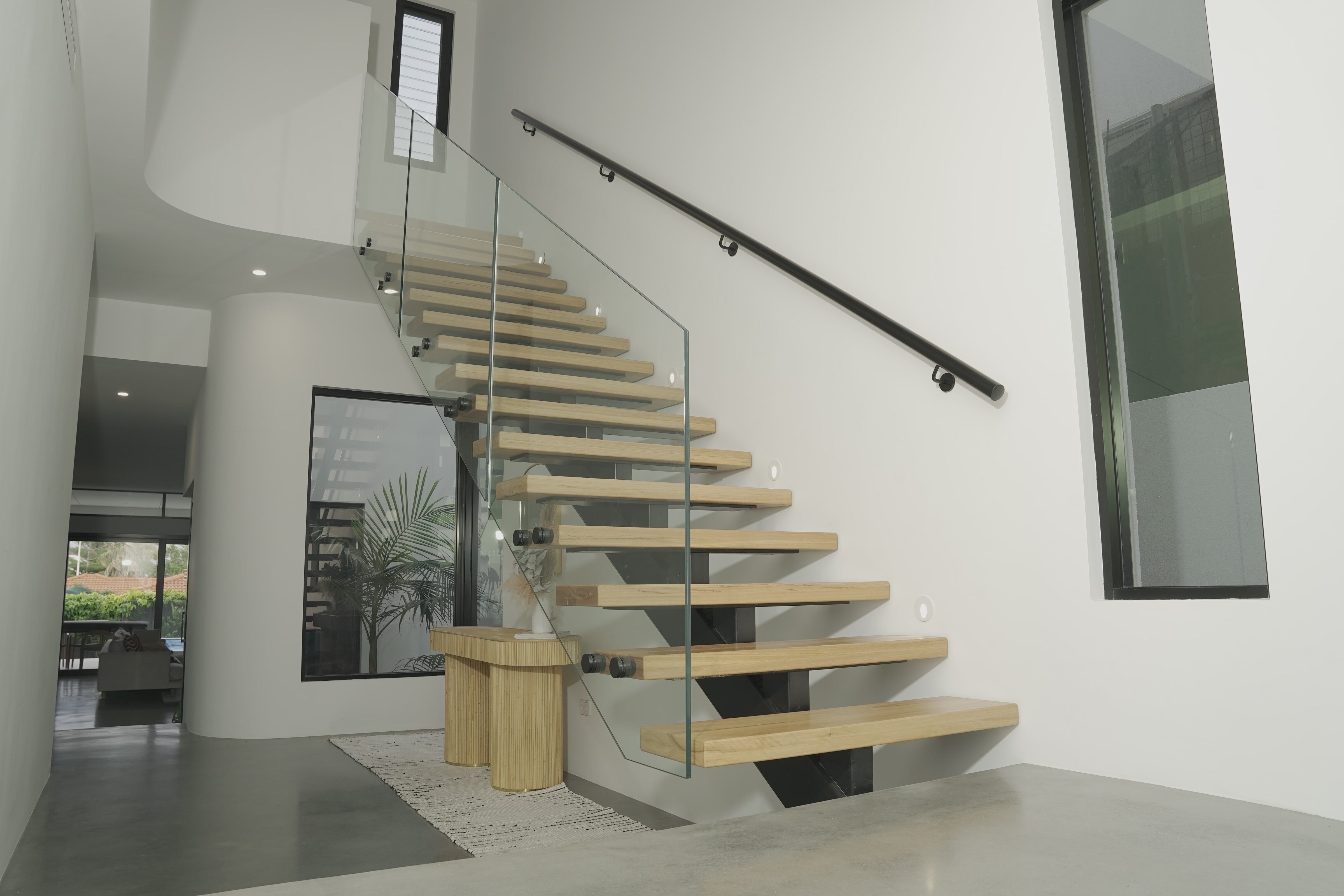
- Floating stairs aren’t actually floating. They’re supported by a hidden steel structure anchored to the wall, floor, or a central spine.
- The “floating” effect comes from concealing the structure entirely, leaving only the treads visible.
- They look impressive, they fully comply with Australian building standards when properly designed, and they’re more accessible than most people expect.
- Understanding the engineering takes five minutes. Deciding if it’s right for your home takes a bit longer. This guide covers both.
When most people see a floating staircase in a display home or on a Pinterest board, they tend to have the same thought: “How is that being held up?” These eye-catching structures look like they’re just hanging in the air and somehow defying physics. The reality is more interesting than the illusion, and once you understand the engineering behind it, the design makes complete sense.
A floating staircase is one of the most defining design decisions you can make in a renovation or new build. It changes the way light moves through your home, the way your floor plan feels, and the way the whole interior reads. For Australian homeowners planning a project like this, it’s worth understanding exactly what you’re committing to so nothing catches you off guard when construction starts.
This guide covers everything you need to know before making a decision: the engineering, the components, the comparisons, and what's actually involved in getting one installed.
What is a floating staircase?
The term “floating staircase” refers to any staircase where the structural support is hidden. This creates the impression that the treads are suspended in mid-air with nothing beneath or behind them. There are no visible risers (the vertical panels between steps), and no traditional timber side panels boxing in the staircase.
The “floating” name describes the aesthetic, not the engineering. Every floating staircase is attached to something substantial. The question is just where and how well it’s concealed.
The most common configuration in Australian homes uses a central steel spine (called a mono-stringer) running beneath the treads, or a cantilevered system in which each tread is fixed directly into the wall. Both create the same visual effect: steps that appear to project out of nowhere, with open space above and below them. The absence of visible risers is also what allows natural light to travel vertically through the structure, which is one of the most practical benefits of these stairs beyond the look.
How does a cantilevered staircase work?
Cantilevered stairs are one of the purest versions of the floating effect, and the most structurally demanding. Each tread acts as a projecting beam, fixed at one end inside the wall and extending freely outward into the room.
To understand the engineering feat, imagine holding a ruler flat against a table and pressing down on the free end. The force doesn’t just push downward; it creates a rotational force (called torque) at the fixed end. A cantilevered stair tread under a person’s weight does exactly this. It creates a significant rotational force at the wall anchor.
Managing that torque is the whole engineering puzzle. The solution is a hidden steel framework inside the wall, which is conventionally three structural steel tube posts running from floor to ceiling. This is concealed within the wall cavity, with heavy-duty steel brackets extending outward to carry each tread. The brackets are welded or bolted to the posts, and the treads are fixed to the brackets. From the outside, you won’t see any of this. Instead, you’ll just see a timber or glass step projecting cleanly from a wall.
This is why the wall condition matters so much with cantilevered stairs. The anchor points need to connect to structural elements, not just plasterboard, and in many cases, a structural engineer will specify exactly what reinforcement is required. High-strength chemical anchor bolts are commonly used at the fixing points, providing superior vibration damping compared to standard mechanical fasteners.
Single spine vs double spine: What’s the difference?
The alternative to cantilevered treads is a stringer system, where a central beam beneath the steps carries the load rather than the wall. Here are the differences between the two:
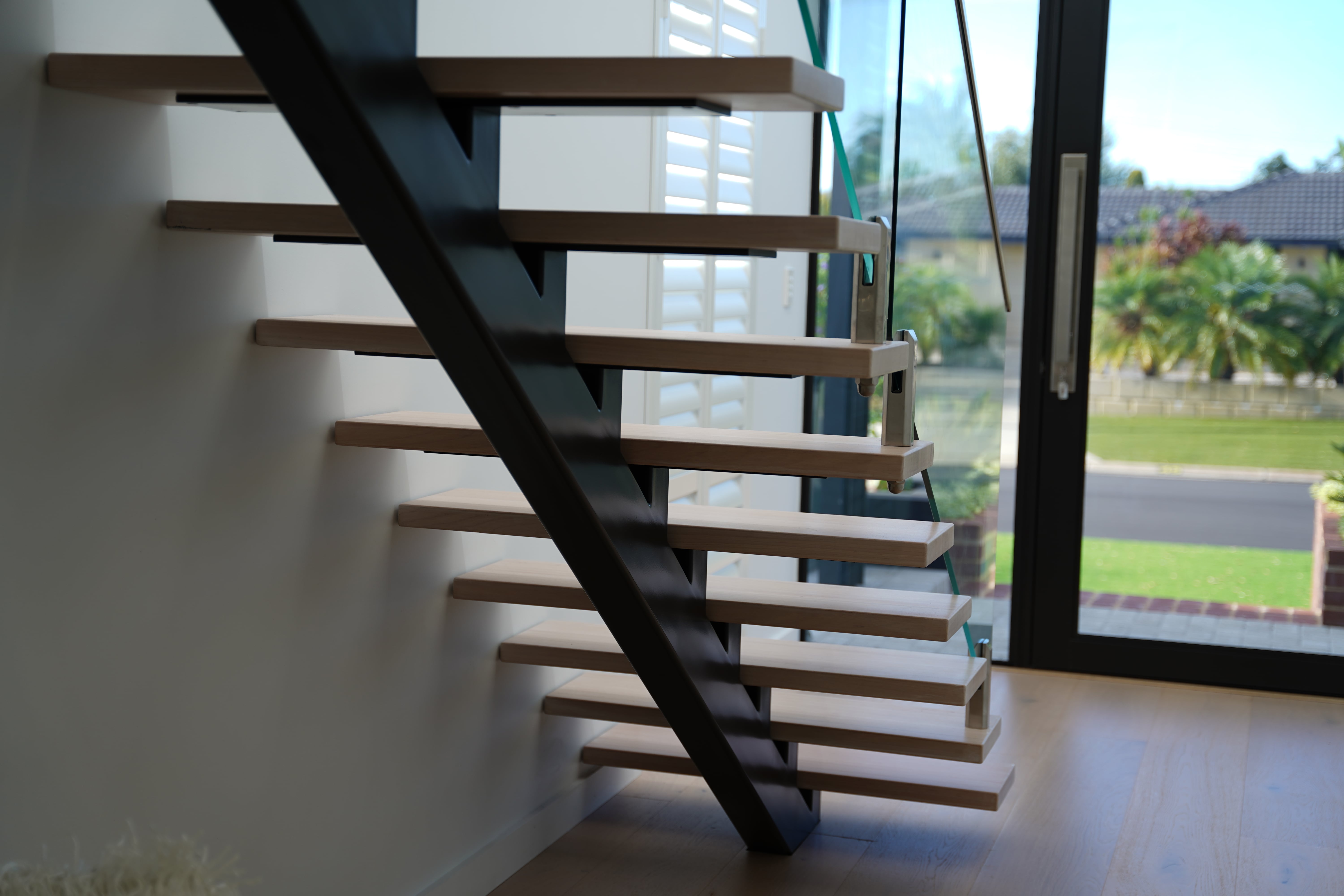
- Mono-stringer (single spine): A single central steel beam runs beneath the staircase from floor to top landing. Steel brackets, sometimes called “vertebrae”, extend from the spine on each side to support the treads. The spine connects to the slab below and the header above, giving it the rigidity to resist twisting. The result is a staircase with one slim, visible line running through its centre, which gives a clean industrial look. You can see through both sides of the staircase, above and below each tread.
- Double stringer (double spine): Two parallel steel beams run beneath the staircase, one on each side of the treads. This shares the load across two points rather than one. As a result, it’s a better choice for wider stairs, heavier tread materials like stone or concrete, or spaces that see a lot of foot traffic. The visual effect is slightly more structural, with both sides of the staircase having a visible beam, but it still achieves the open, floating appearance.
As a general rule, narrow stairs in a residential setting suit a mono-stringer. Wider stairs, heavier materials, or any commercial application typically call for a double stringer. Cantilevered systems are ideal when you want maximum openness and have the right wall structure to support them.
The anatomy of a floating staircase
Understanding the individual components helps when you’re discussing options with a staircase specialist. Here’s how each part contributes to the final result.
The stringer (the backbone)
Whether it’s a mono-stringer, double stringer, or concealed wall frame, the stringer is the primary load-bearing element. Modern floating stair stringers are almost always fabricated from steel. It has a tensile strength to support significant loads while staying slim enough to remain visually unobtrusive. A quality stringer is laser-cut to match the exact riser and going dimensions for your specific staircase.
Treads (the vertebrae)
Treads are the horizontal surfaces you step on. In floating designs, they’re typically made thicker than traditional options, often 60mm to 100mm deep, partly for structural reasons and partly to allow the steel bracket from the spine or wall to be concealed inside the tread material. This “sleeving” technique is what gives floating treads their clean, fixing-free appearance. The connection is hidden inside the step itself.
Material choices include solid hardwood (Tasmanian Oak, Spotted Gum, and Blackbutt are popular in Australia), toughened glass, powder-coated steel, or stone. Each has different structural implications. Glass and stone require additional internal steel framing to manage load distribution, while timber and steel are more forgiving.
Balustrade and handrail
Open-riser stairs need a compliant balustrade system. To maintain the floating aesthetic, most homeowners choose glass panels (either channel-fixed or side-mounted) or slimline stainless steel cables. Both provide the required safety without the visual weight of traditional timber balusters.
The handrail runs along the top of the balustrade, and it can either match the main material or contrast with it. For instance, a timber handrail on a glass balustrade is a popular choice that adds warmth to an otherwise minimalist design.
Connectors and fixings (the joints)
The mechanical integrity of the whole system depends on what’s happening at each connection point. In a cantilevered design, this means telescoping support studs and high-strength bolts fixing each tread to the hidden wall frame. For glass balustrade systems, stainless steel spacers and standoffs distribute the load across the panels without creating concentrated pressure points that could compromise the laminated layers. These components are invisible in a finished staircase, but they’re doing significant structural work.
Open risers and the 125mm rule
One of the first compliance questions that comes up with floating stairs is the open riser. Australian standards require that no opening in a staircase allow a 125mm sphere to pass through. This rule is designed to prevent young children from falling through the gaps.
For most residential floating stairs, this means adding a small horizontal element between treads (sometimes referred to as a riser reducer or dummy riser) that narrows the gap just enough to meet the standard. Done well, it’s barely noticeable and doesn’t compromise the floating look. The staircase still reads as completely open.
Floating, spiral and helical stairs: What’s the difference?
These three staircase types are often grouped together because they all have design ambitions beyond a standard straight staircase. That said, they’re quite different in practice.
Spiral stairs are defined by their central column. Every tread radiates outward from a single vertical pole, creating a wedge shape that narrows significantly toward the centre. They’re the most space-efficient option and can fit into compact footprints, but the narrow walking path and steep incline make them harder to navigate comfortably, and moving furniture up or down them is nearly impossible.
Helical stairs (also called curved stairs) follow a circular or sweeping path but have no central column. They wind around an open void. They’re spectacular and walk beautifully, but they require a large footprint and a substantially larger budget. They’re typically found in grand foyers and high-end architectural builds.
Conversely, floating stairs are defined by their hidden support system, not their shape. They can be straight, L-shaped, or even curved. Their defining characteristic is the absence of visible structural elements, not a specific floor plan. A floating staircase occupies a similar footprint to a standard straight staircase, and is far easier to navigate than a spiral, while being considerably more achievable than a helical design for most renovation budgets.
If you’re weighing up replacing a spiral staircase, a straight floating design is the most common outcome, but the footprint change from a tight spiral to a straight run is something to verify early in your planning.
What to consider before choosing a floating staircase
Understanding how floating stairs work is the first step. The second is working out whether your home is the right fit. Here are key details worth thinking through before going ahead with a floating staircase.
Available space and run length
A floating staircase needs a longer horizontal run than a spiral. Australian standards specify a going of at least 240mm per step and a riser no higher than 190mm. You’ll need to work through those dimensions against your floor-to-floor height to understand how much horizontal space that staircase will require. Aussie Stairs can help you model this accurately.
Ceiling height and head clearance
The National Construction Code (NCC) requires a minimum of 2,000mm of headroom along the full length of the staircase. In older homes with lower ceilings, this can affect where the staircase can begin and end.
Floor and wall structure
For cantilevered designs, the wall needs to accommodate the hidden steel framework. For spine-based design, the floor slab at the base and the structure at the top landing both need to support the connection points. A structural engineer assessment is standard practice, not an optional extra.
Subfloor preparation
The area beneath the staircase and around the installation points may need reinforcement or modification before the staircase can be fitted. This is identified in the structural assessment.
Council and BCA compliance
Floating staircases comply fully with the NCC when designed correctly. Working with Aussie Stairs means compliance is built into the design from the start, not retrofitted. For a detailed breakdown of the relevant standards, see our guide to stair regulations in Australia.
What’s involved in replacing a spiral staircase with floating stairs?
Replacing a spiral staircase is one of the most common conversations Aussie Stairs has with renovation clients, and it’s a project worth planning carefully.
The first thing to understand is that a spiral staircase concentrates its load at a single central point on the floor. A floating staircase distributes load differently, as it typically fixes to the slab at the base and connects to the first-floor structure at the top. That change in load distribution is why a structural engineer needs to assess the existing slab before anything is committed. Depending on the findings, additional steel or LVL timber beams may be required to reinforce the header where the staircase connects to the upper floor.
The second consideration is space. Spiral stairs are compact by design, requiring significantly less floor space than a straight staircase. A straight floating staircase requires a longer run through the floor plan, which might mean adjusting walls, doorways, or the position of the opening in the upper floor. Getting a proper measurement of your available space, including run length and ceiling height, is the essential first step.
Most spiral-to-floating replacements follow the same four-step sequence:
- Space audit: Verify available run length, ceiling height, and head clearance against Australian Standards (AS 1657). Not sure what any of that means in practice? Our stair standards page breaks it down clearly.
- Structural analysis: A structural engineer assesses the existing slab, load-bearing walls, and upper floor header to confirm what reinforcement is needed.
- Frame preparation: A carpenter or steel fixer prepares the fixing points for the new staircase, including any slab or header reinforcement identified in step two.
- Installation: The fabricated floating stair system is delivered and installed by specialists. This stage is typically faster than most clients expect.
If you’re considering this kind of replacement, our team can walk you through exactly what’s involved in your specific home.

What drives the cost of a floating staircase?
This is a question that comes up early and often. Floating stairs are a considered investment, and the final cost varies significantly based on the choices involved.
The main factors are:
- The number of treads (more treads means more material and more engineering)
- The span of each tread (wider treads require more structural support)
- The material selected for the treads (hardwood and glass sit at different price points than steel)
- The balustrade type (glass is typically the premium option)
- The structural complexity of the installation site
Moreover, cantilevered systems tend to be more involved than spine-based systems due to the wall preparation and internal steelwork required. Double-stringer systems add material cost relative to a mono-stringer. These aren’t reasons to avoid the design. They’re just the variables that influence a quote.
The best way to understand the cost of your specific project is to get a design consultation rather than working from ballpark figures. Variables like your floor-to-floor height, wall material, and tread choice can shift the number substantially.
Benefits that go beyond the look
The visual impact of a floating staircase tends to lead the conversation, but there are practical reasons the design makes sense beyond aesthetics. Understanding how floating stairs work makes the practical benefits easier to appreciate.
Removing risers allows light to travel vertically through the staircase. In multi-storey homes, this can channel sunlight from upper windows or skylights down into spaces that would otherwise be in shadow. It’s a material difference to how the interior feels, particularly in Perth’s longer daylight hours.
Traditional staircases enclose the spandrel (the triangular space beneath the stairs) behind plasterboard and timber framing. By contrast, a floating design opens the floor plan. You can see through and past these structures, which makes the rooms on either side of the staircase read as larger. Homeowners regularly use the space beneath the treads for built-in storage, a home office nook, or a wine display.
Floating stairs also work across a wide range of interior styles. A timber-tread mono-stringer suits a warm contemporary home. A glass-tread cantilevered design suits a minimal, light-filled space. Powder-coated steel reads as industrial or architectural depending on the surrounding palette. The “floating” engineering principle is the constant, while the visual expression varies considerably.
A high-quality floating staircase is also a feature that buyers notice and that agents reference. Done well, it positions the home in a different category.

Ready to see a floating staircase in person?
Reading about how floating stairs work is useful. Seeing one built to Aussie Stairs’ standard, and standing on it, is something else entirely. Our Perth showroom is where most clients go from curious to certain.
With over 400 five-star Google reviews, we let the work speak for itself. The next step is simple: book a consultation with our team, or visit us at our Perth showroom in Maddington. Bring your floor plan, your dimensions, and your questions; we’ll take it from there.
Frequently asked questions
Are floating stairs safe?
Yes, when designed and installed to Australian standards, floating stairs are every bit as safe as a traditional enclosed staircase. They’re subject to the same NCC requirements for riser height, tread depth, head clearance, balustrade height, and slip resistance. The structural steel used in modern floating stair systems is engineered to far exceed standard residential load requirements, and all Aussie Stairs staircases are engineer-certified to Australian Standards.
Do floating stairs feel sturdy underfoot?
A well-engineered floating staircase feels completely solid. The “bounce” or subtle movement that some people associate with floating stairs is a symptom of under-engineered support. The usual culprits are a stringer that’s too thin or anchoring that isn’t up to the job. Properly specified and installed systems feel rigid and stable. If you’d like to understand exactly how our system manages tread movement, our team can walk you through it.
Can floating stairs work in an older home?
Often, yes, but it depends on the wall and floor structure. Cantilevered systems need a suitable wall to anchor into, and spine-based systems need sound connections at the base and top. A structural engineer assessment will tell you definitively what’s possible in your specific home. Many older homes have been successfully retrofitted with floating stairs.
What’s the difference between floating stairs and cantilevered stairs?
One of the most common questions, alongside how floating stairs work, is how they differ from cantilevered stairs specifically. The phrase “cantilevered stairs” describes a specific structural method where each tread extends from a wall anchor with no visible support beneath. “Floating stairs” is a broader term covering any staircase where the support structure is hidden. This includes cantilevered designs, mono-stringer designs, and double-stringer designs. Put simply, all cantilevered stairs are floating stairs, but not all floating stairs are cantilevered.
How long does installation take?
The installation of the staircase is typically completed in one to two days for a standard residential flight. The total project timeline is longer because it includes the structural assessment, design approval, fabrication of the steel components, and site preparation. From initial enquiry to installation, most projects run six to twelve weeks, depending on complexity and lead times.


-min.jpeg)


.svg)